Federico Mora · University of Waterloo · Fall '26 · Tues 3:00-5:50pm · DC 2585
⬅️ ➡️ move between slides · ⬆️ ⬇️ jump between sections
Our meetings will be centered around paper discussions and in-class activities. Attendance, reading of assigned papers, and participation are essential.
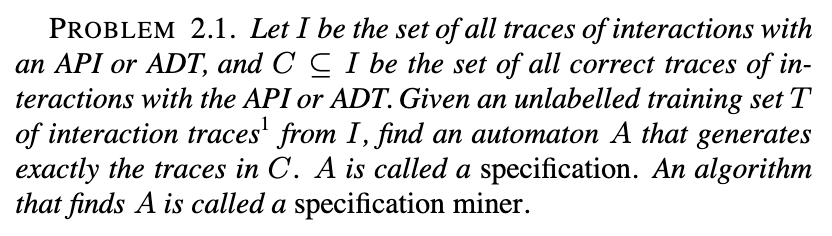
Every project must contain new research—a new idea or insight—and an element of both formal methods and artificial intelligence. Students can work in groups of up to three.
For research papers, discussion leads present a review with four components:
For textbooks, discussion leads give a 30-minute tutorial. For blog posts, discussion leads give a 30-minute deep-dive.
All due dates are end of day on the date listed.
| Date | Description | Read |
|---|---|---|
| Sep 15 | Introduction and overview | 1, 2 |
| Sep 15 | Discussion preferences due | |
| Sep 22 | Agents and tool-use ATU | 1, ? |
| Sep 29 | Constraints on LLM outputs CLO | 1, ? |
| Oct 06 | Generating system constraints GSC | ? |
| Oct 09 | Proposals due | |
| Oct 20 | Satisfiability (modulo theories) SAT | 1, ? |
| Oct 27 | Program verification PVE | 1, ? |
| Nov 03 | Mini presentations day | |
| Nov 10 | Superoptimization SUP | ? |
| Nov 17 | Theorem proving TPR | ? |
| Nov 24 | Machine-learning verification MLV | 1, ? |
| Dec 01 | Bonus | 1, ? |
| Dec 08 | Final presentations day | |
| Dec 18 | Reports due |
The NeuroSAT neural network architecture was introduced in [37] for predicting properties of propositional formulae. When trained to predict the satisfiability of toy problems, it was shown to find solutions and unsatisfiable cores on its own. However, the authors saw "no obvious path" to using the architecture to improve the state-of-the-art. In this work, we train a simplified NeuroSAT architecture to directly predict the unsatisfiable cores of real problems. We modify several high-performance SAT solvers to periodically replace their variable activity scores with NeuroSAT’s prediction of how likely the variables are to appear in an unsatisfiable core.
In short,
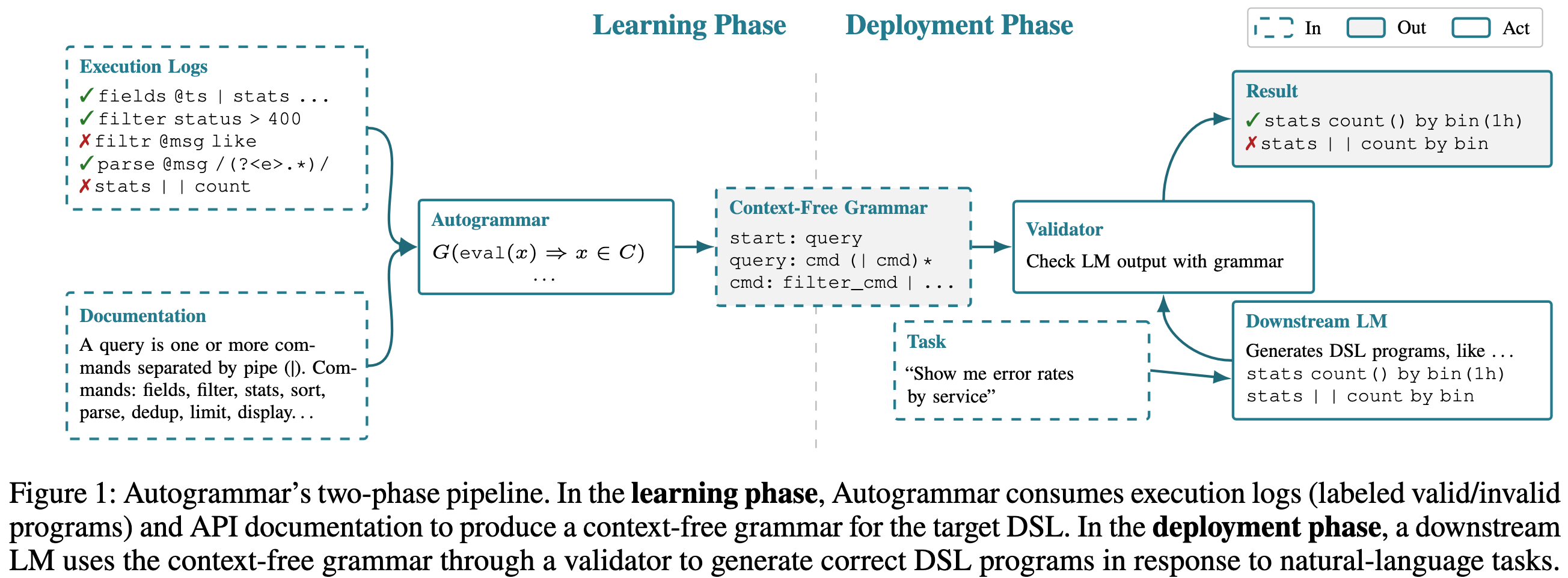
... we use it to help inform variable branching decisions within high-performance SAT solvers on real problems.
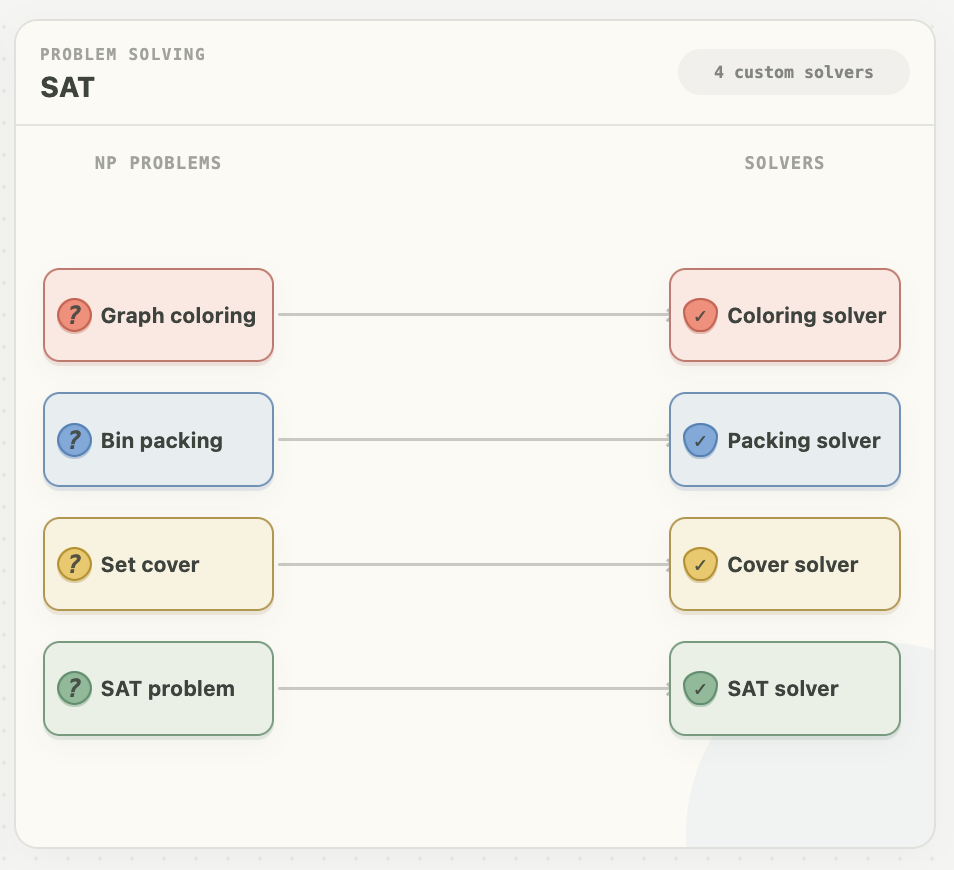
It has been widely observed that there is no single "dominant" SAT solver; instead, different solvers perform best on different instances. Rather than following the traditional approach of choosing the best solver for a given class of instances, we advocate making this decision online on a per-instance basis.
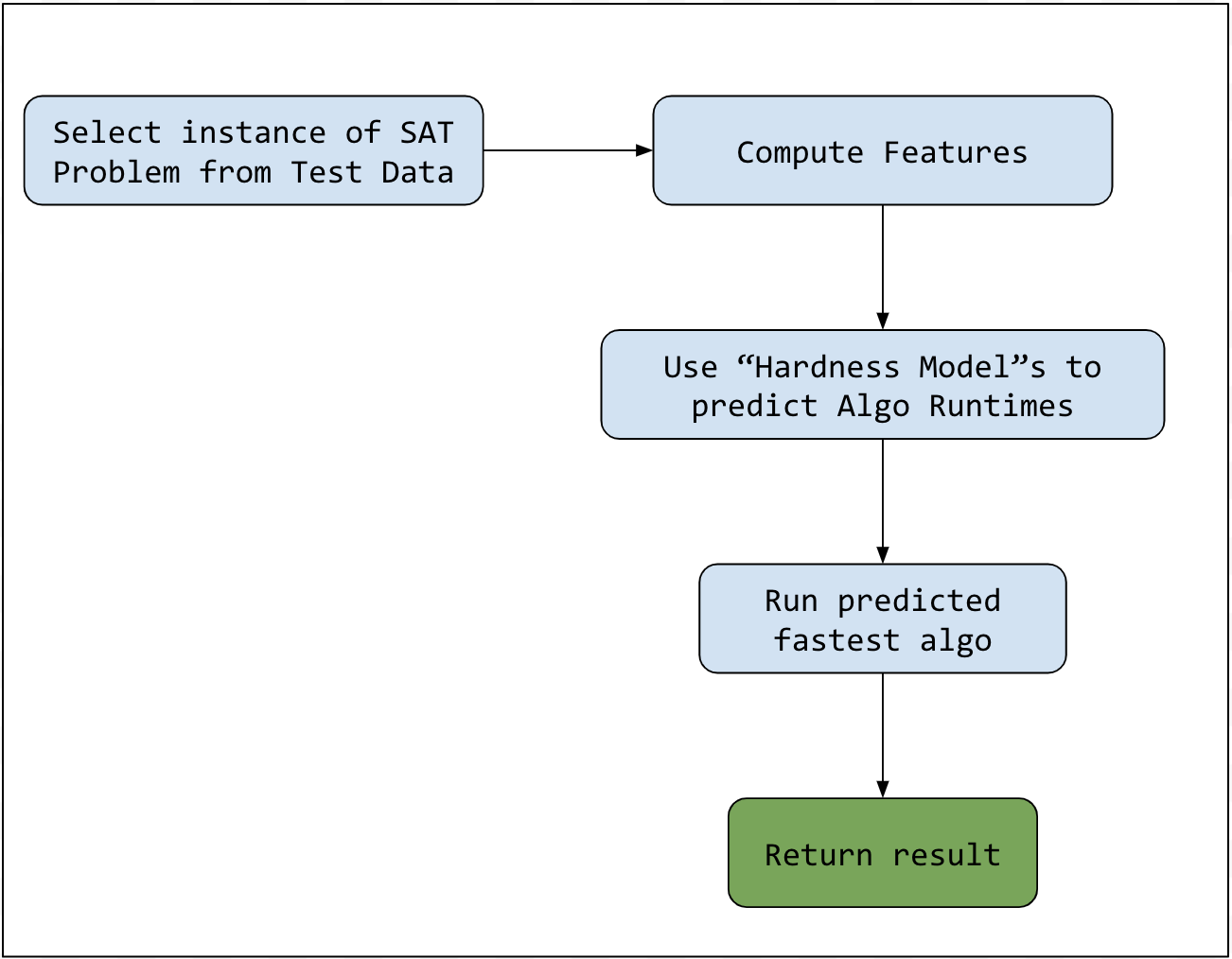
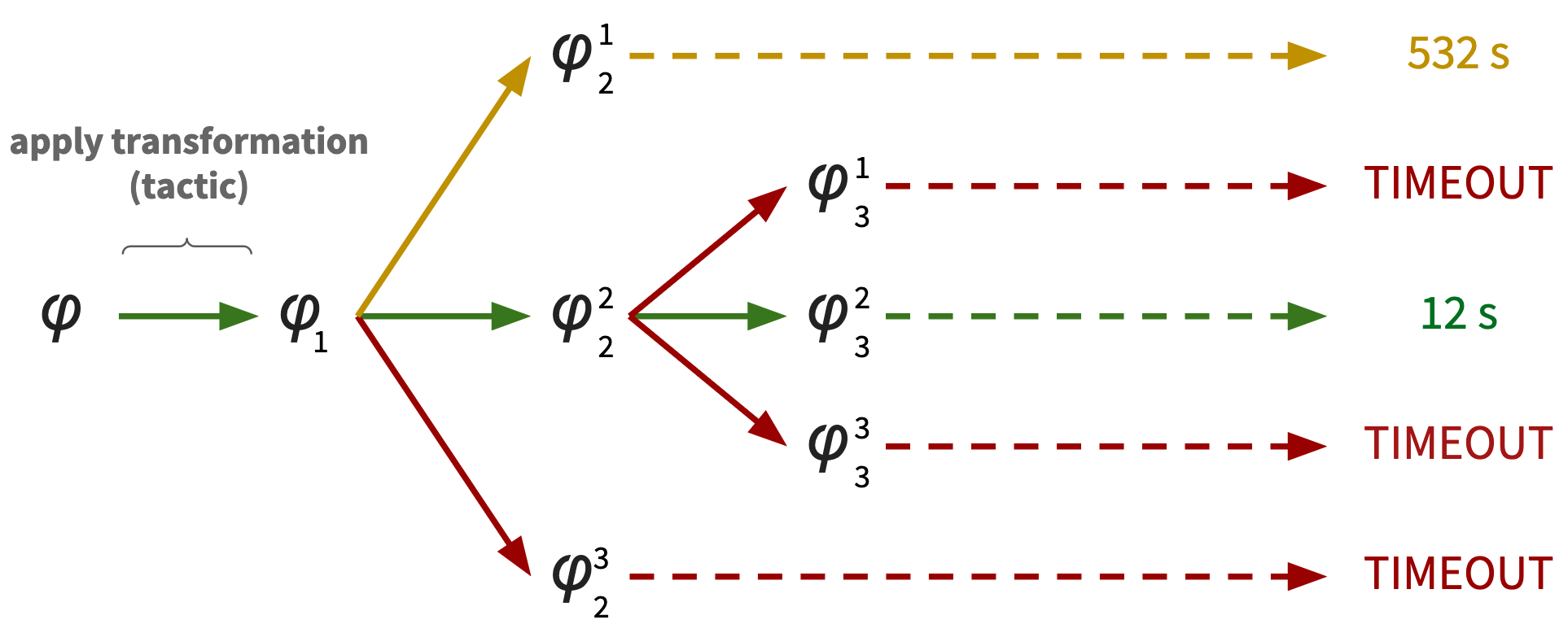
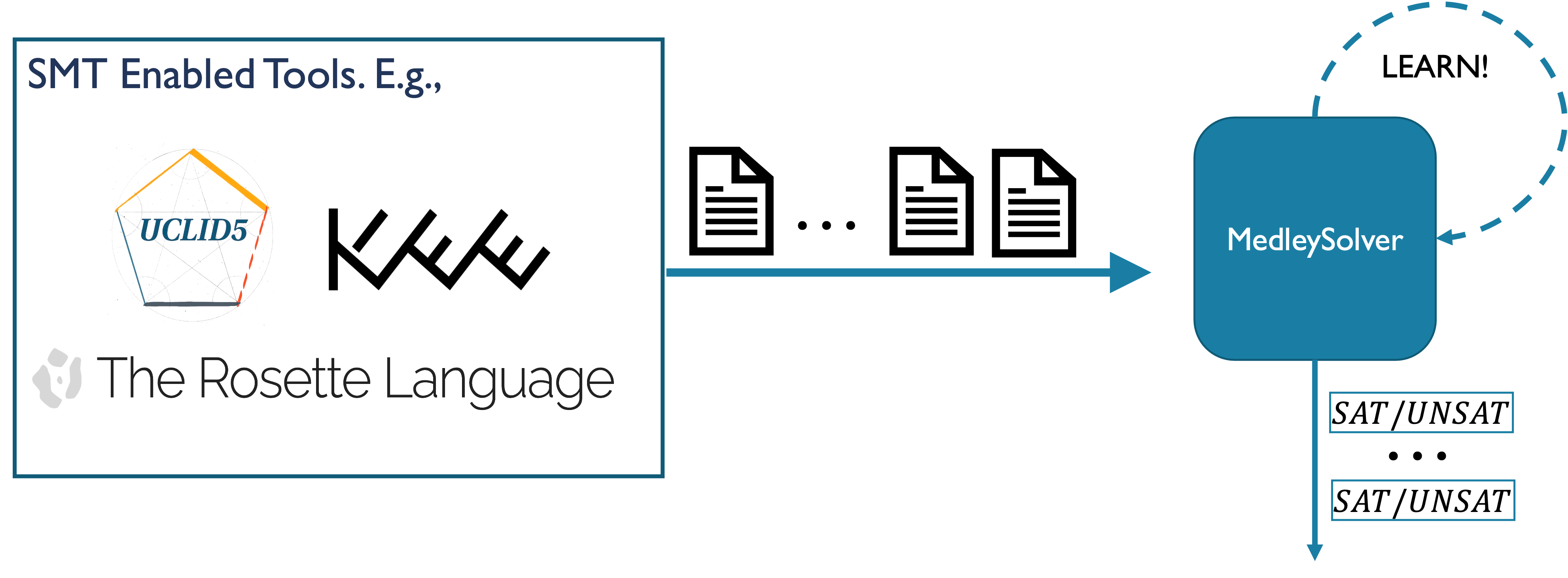
SMT users rarely aim to solve a single query in isolation and usually care about [total] resource consumption. For example, verification engines generate many verification queries for one verification problem and aim to solve these queries in the least amount of time.
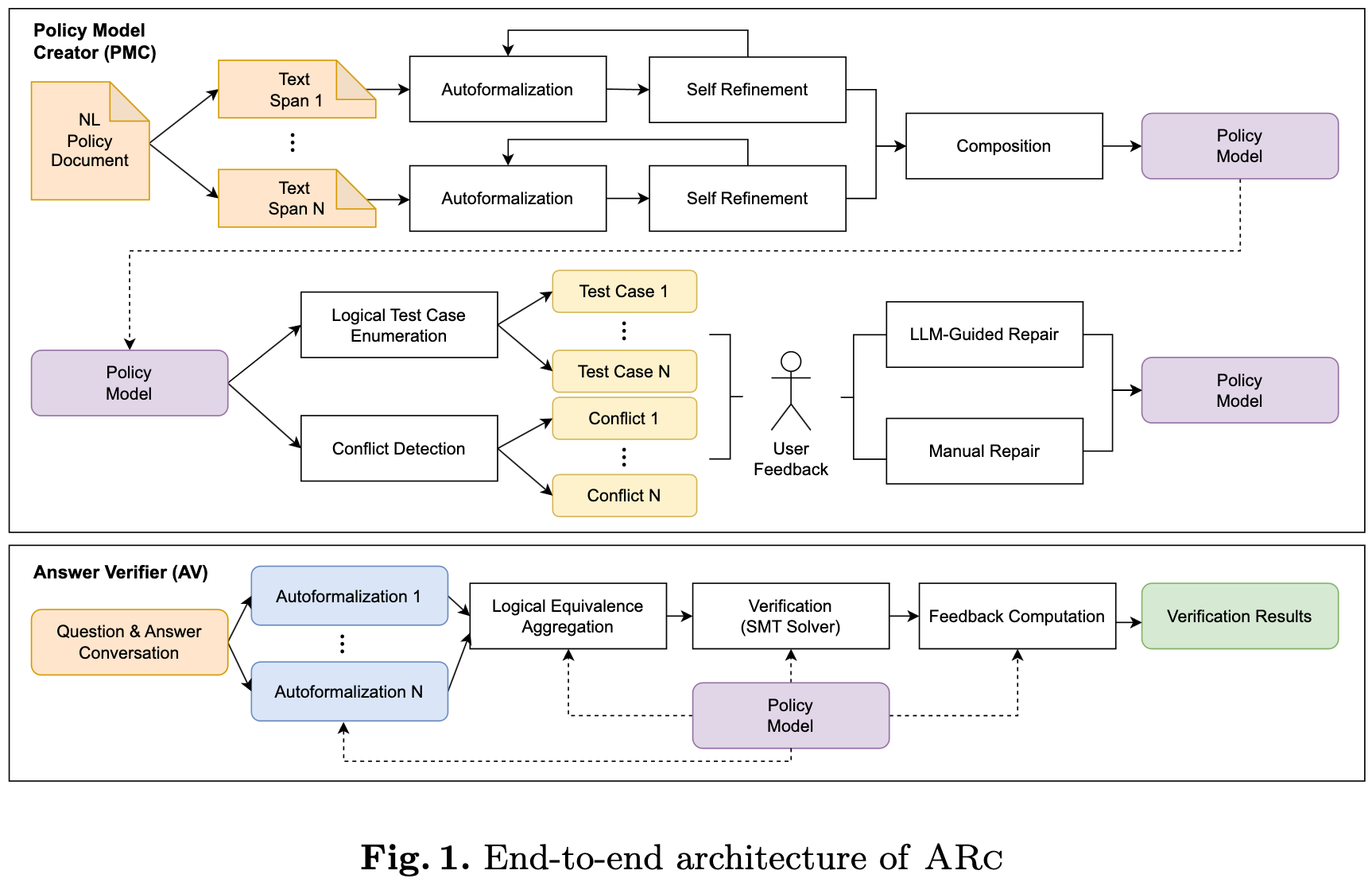
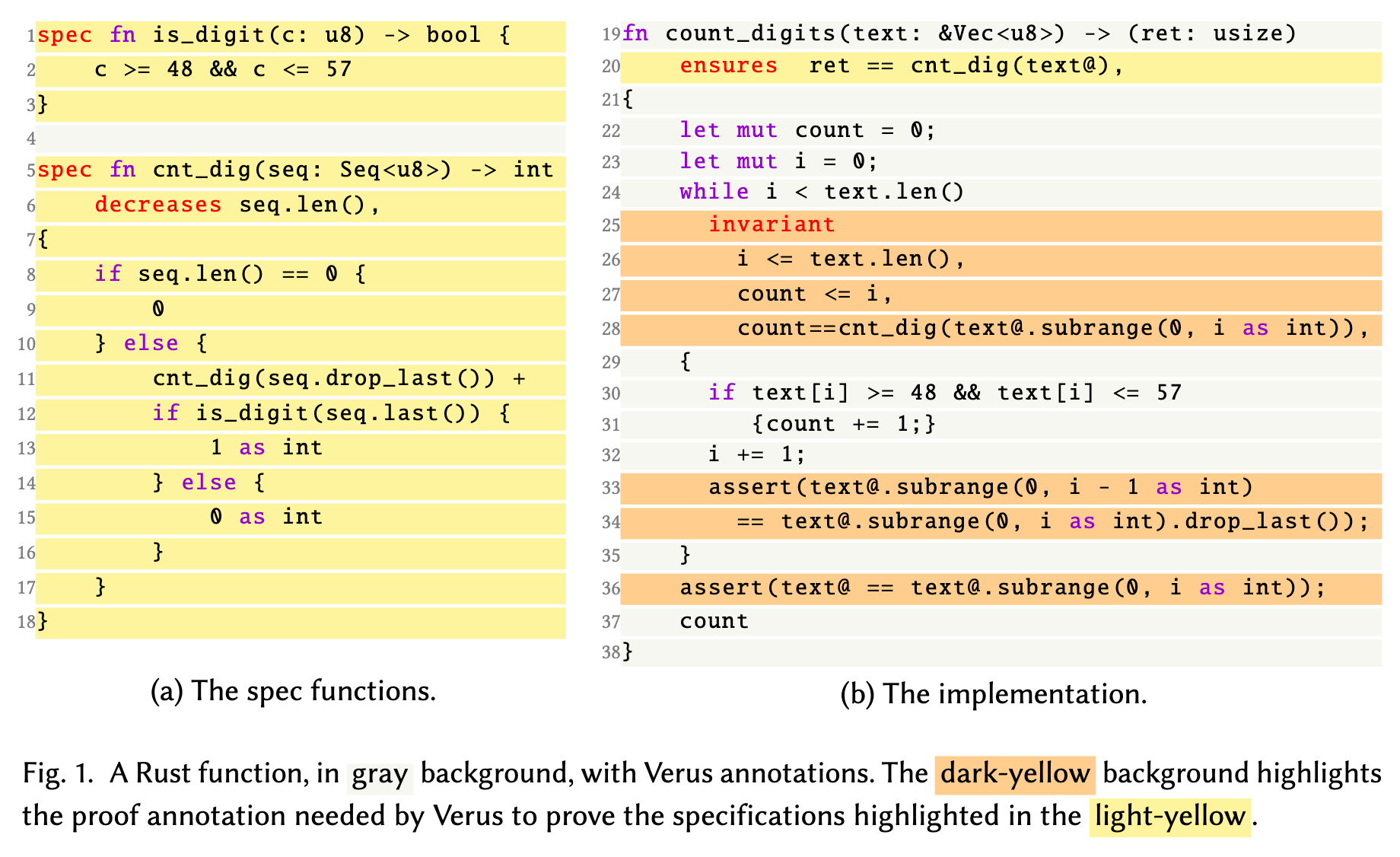
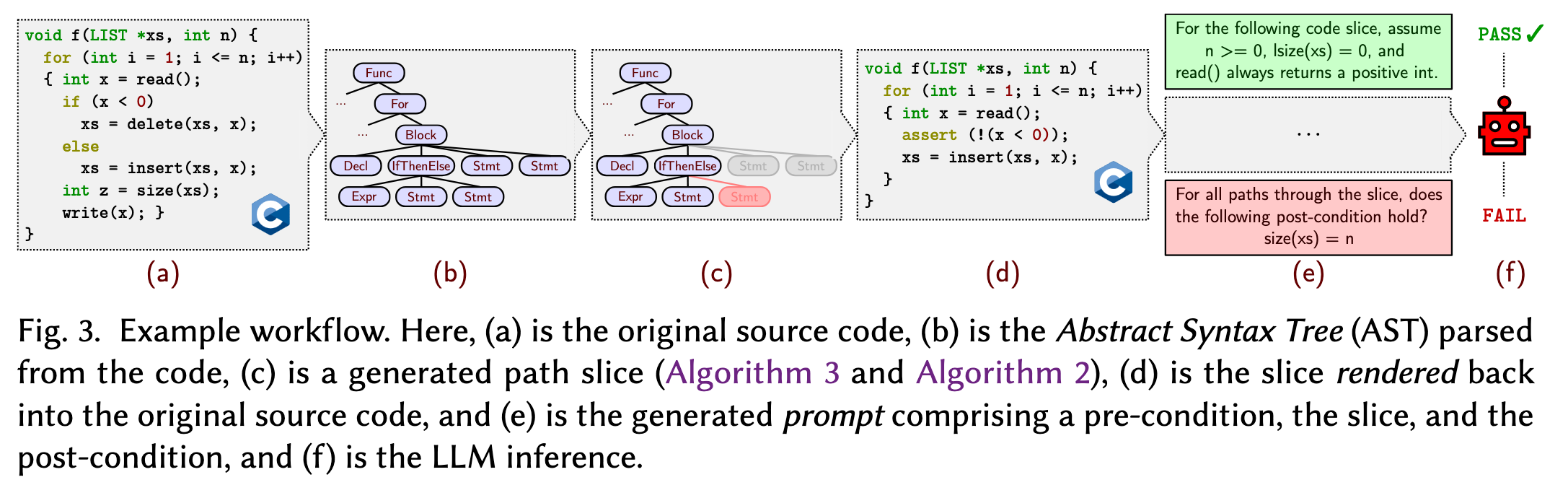
Verifiable code generation—jointly generating code, specifications, and proofs of code-specification alignment—offers a promising path to address this limitation and further unleash LLMs’ benefits in coding. Yet, there exists a significant gap in evaluation: current benchmarks often focus on only individual components rather than providing a holistic evaluation framework of all tasks.
But proof success is quite low:
The best model, OpenAI o3, achieves a 72.6% code correctness rate, 52.3% for specification soundness and completeness, and a mere 4.9% proof success rate (based on one trial per task).
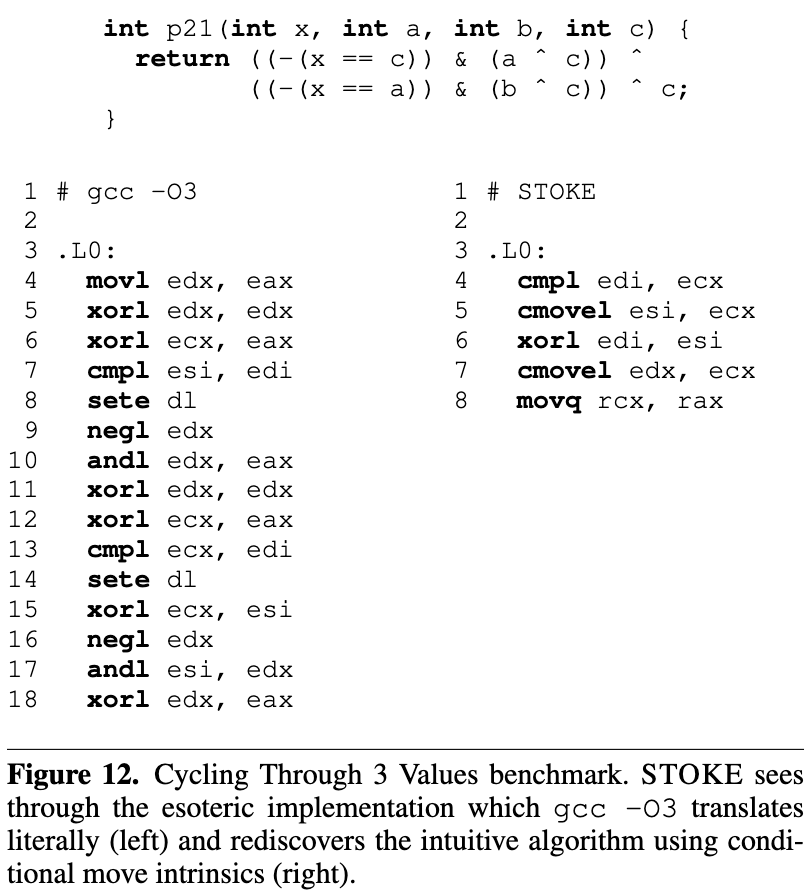
you have the "slow" expression
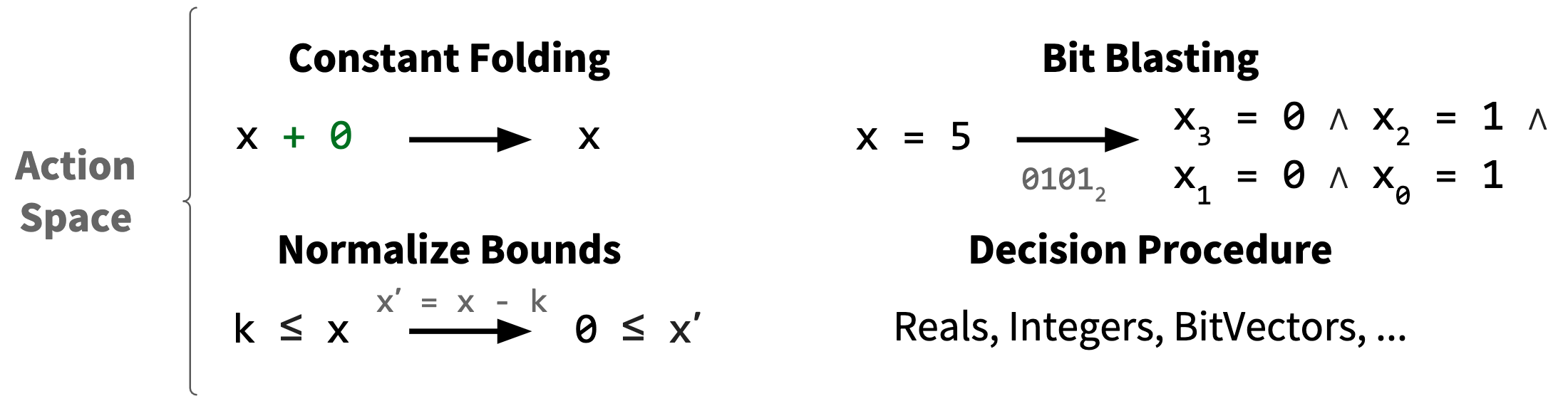
x * 2, and you know that there's a "faster" version to be had that can be writtenx << ??for some value of??. Let's ask Z3 what to write there...
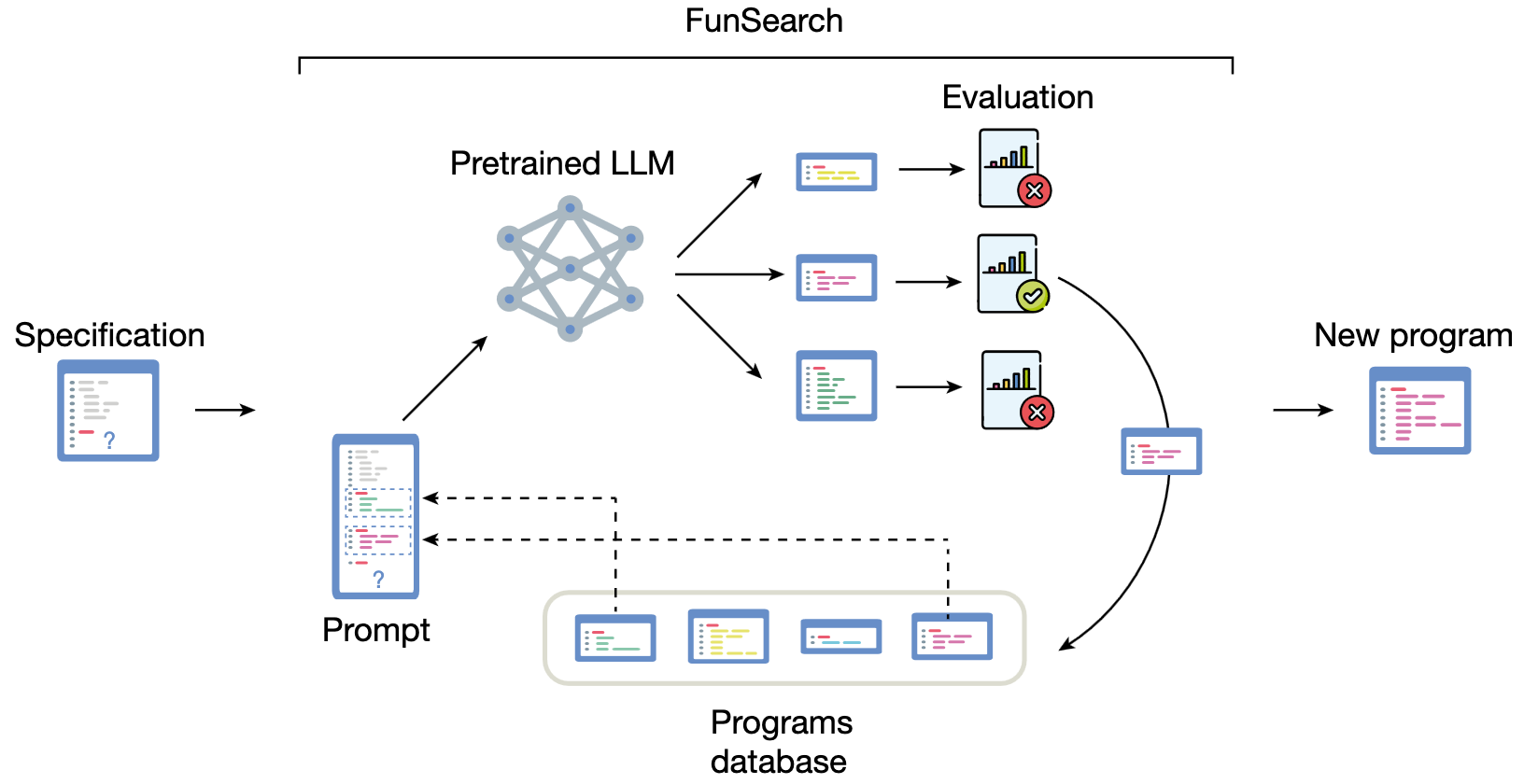
Romera-Paredes et al., Nature '23
We present an automated prover and proof assistant, GPT-f, for the Metamath formalization language, and analyze its performance. GPT-f found new short proofs that were accepted into the main Metamath library, which is to our knowledge, the first time a deep learning based system has contributed proofs that were adopted by a formal mathematics community.
On July 25, Ramana Kumar published a repository containing a
sorry-free "disproof" of the Collatz conjecture, produced with AI assistance. It is not a valid proof because it exploits a bug in the kernel's handling of nested inductive types.
This book is about verifying that a neural network behaves according to some set of desirable properties.
Importantly,
A number of people in the verification community, the author included, argue that specification [deciding on the set of desirable properties] is harder than verification—that is, the hard part is asking the right questions!
(vnnlib-version <2.0>)
; Network declaration
(declare-network f
(declare-input X float32 [2,2])
(declare-output Y float32 [1])
)
; Input constraints
(assert (and (>= X[0,0] 0.0) (<= X[0,0] 1.0)))
(assert (and (>= X[0,1] 0.0) (<= X[0,1] 1.0)))
(assert (and (>= X[1,0] 0.0) (<= X[1,0] 1.0)))
(assert (and (>= X[1,1] 0.0) (<= X[1,1] 1.0)))
; Output constraints
(assert (or (<= Y[0] -3.0) (>= Y[0] 0.0)))
Submit your discussion preferences today through the LEARN quiz.
You will be matched to papers based on your submitted preferences on Sep 16.